Most B2B marketing advice isn’t intended for mid-market. Ours is, starting with our take on last week’s Forrester B2B Summit. Welcome to Tailwind Marketing.
Last week at the Forrester B2B Summit, the case studies on stage were from companies that averaged more than $20 billion in revenue (e.g. IBM, SAP, Adobe, ServiceNow, Xerox, Rockwell Automation), but most of the audience were representing companies of under $1 billion. For me, the fact that this gap wasn’t even acknowledged is more telling than any of the talks.
Don’t get me wrong, the diagnosis was sharp:
- Decision makers don’t trust marketing measurement, and AI search is rocking already dubious KPIs like traffic and MQLs
- AI search is reshaping how buyers find you, and traditional search is collapsing as a discovery channel
- Most deals are won by whoever was already the preferred vendor before the buying process even started
The problem is the so what: how do we interpret them, and what do we do about it? And unless I’m a Fortune 500 company, I wouldn’t trust Forrester to answer that for me.
“If you ain’t first, you’re last”
Ok this quote is from Ricky Bobby in Talladega nights, but Forrester did use a racing analogy when explaining the concept of preference marketing: whoever is in the pole position of the buying process wins the race most of the time, since “68% of B2B buyers have a preferred vendor at the start, and 80% of the times the preferred vendor is selected” (68% x 80% = 54%). I’m all about a competitive mindset in both sports and business, but I’m not sure how you conclude that giving up is the answer:
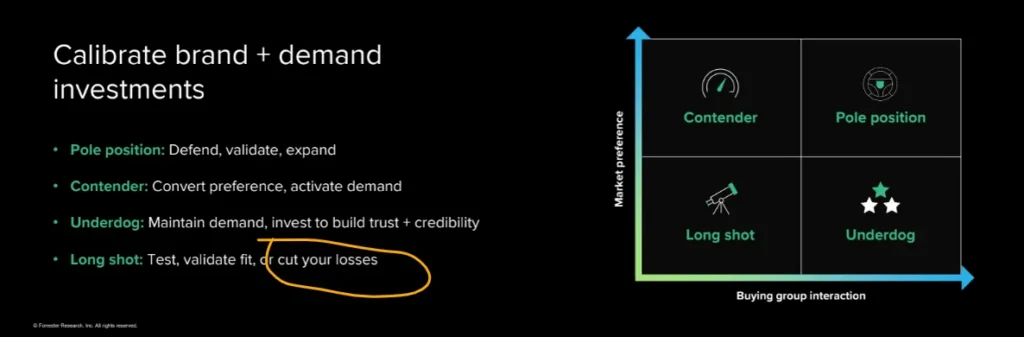
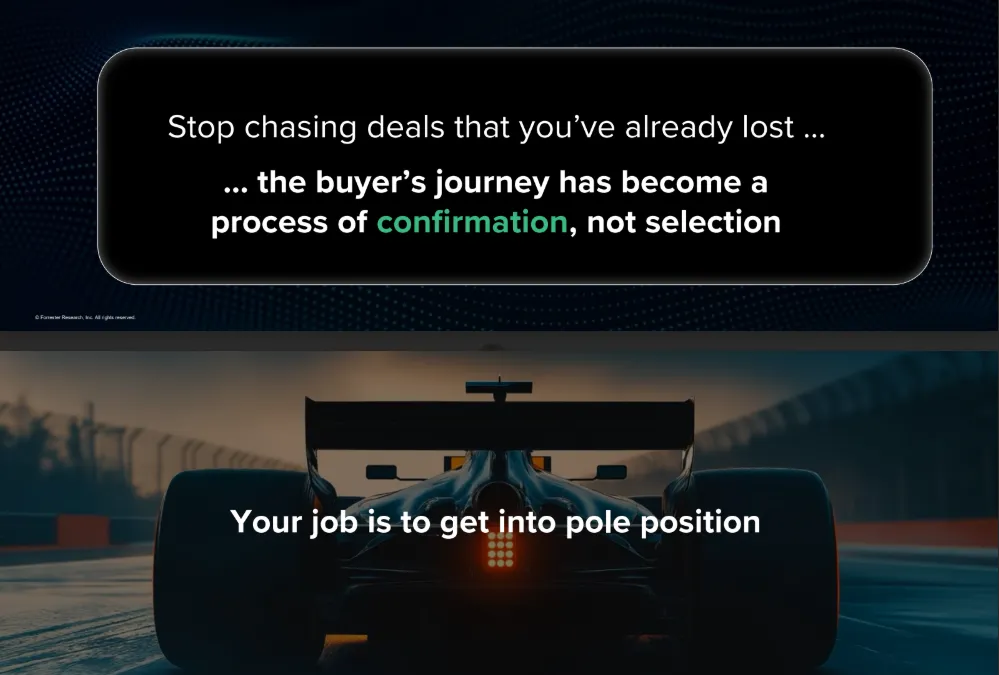
I think they didn’t read the room with this one. Most of the audience wasn’t thinking about their industry podium because they’re probably not even in the top 10. In mid-market, we’re not racing to win the category. We’re racing to win one new client at a time.
And my favorite topic: measurement.
Probably because it’s my favorite, I also thought it was the most alarming POV of the summit. The breakout session started strong: engagement metrics like clicks, MQLs, and web traffic were never strong predictors of pipeline to begin with. AI search is weakening those signals even more. CTRs are dropping dramatically in answer-engine results, and the measurement model most B2B companies use is heading for a wall. So far I’m thinking “you had me at hello! I couldn’t agree more. This is the breakout that will pay for the conference.” But then the prescription started: demote pipeline measurement along with the rest of the engagement data, and reorient marketing’s accountability around what they call Return on Objectives: a sort of OKR that cascades from business goals to marketing priorities:
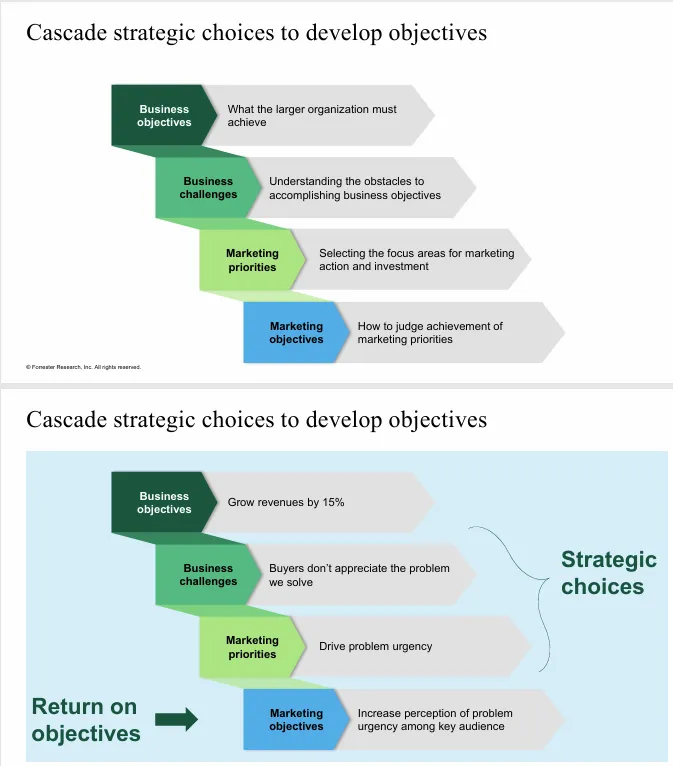
I tried to give the speaker some time. Maybe this was just the first of a set of recommendations. But as he walked through example after example of the so-called ROOs, I realized that was it. Like when you’re waiting at the end of the concert for the band to come back, but people start to leave, the sound guys pick up the instruments, the lights start to come on, and at some point you say ok that’s it, show’s over. Looking at other faces in the room I knew they were feeling the same. They even tried to force an encore in the final round of questions, with several marketers asking, in different ways, if this framework was in addition to pipeline measurement, not in replacement, or if there were other recommendations on how to increase trust with the CFO. But the speaker held his ground, and the session ended with more tension than resolution. I talked about it afterwards with another attendee who runs paid media for a B2B tech company: “One day we’ll solve the marketing contribution measurement problem,” she said. “That just wasn’t the day.”
I’ll give you my encore: I agree that traffic and MQLs are far from the money, but the fix is to get closer (SQLs, opportunities, new clients, revenue), not to look further away: looking into fractional and advanced attribution, understanding what channel, content and messaging are working to move each ICP through the funnel, aligning sales and marketing on KPIs and GTM strategy, to name a few. There’s also a second problem with using OKRs or perception metrics alone: it gives weak marketers a place to hide. We’ve all seen agencies or marketing leaders using brand favorability to prove marketing’s value and buy themselves another quarter. What I recommend to my clients is to split their budgets in three buckets, and measure each one for what it’s supposed to do: 1 demand gen has to generate pipeline and revenue (usually the bucket with the highest investment); 2 brand has to generate awareness in our ICP and, why not, change certain perceptions; and 3 operations can get its own OKRs for supporting sales with new service pages, collateral, and internal enablement. But I wouldn’t go to the board without the pipeline report.
Our promise
When your team reads enterprise research, make sure they can recognize both Fortune 500 problems and luxuries, and ignore them. The same dissection goes for advice built mostly for startups and SMBs btw (e.g. HubSpot). Mid-market sits between two louder rooms, and most of the advice in circulation was written for one of them.
Forrester and Gartner are reading the weather. We’re going to help you actually sail your boat. Welcome to Tailwind Marketing.